
A New Approach to White Cast in Mineral SPF [White paper]
Evaluating a bio-circular solution for improved cosmetic elegance.
Sign in for updates on our ongoing research on SPF-boosting, colour palette tunability, and more.
EXECUTIVE SUMMARY
Sun protection is becoming an everyday skincare essential. As SPF moves into moisturisers, serums, makeup, and other daily-use formats, effective UV protection is no longer enough: consumers increasingly expect the refined finish, skin feel, and wear experience associated with premium skincare. For mineral sunscreens, white cast remains a significant barrier to meeting those expectations, particularly on deeper skin tones.
Existing approaches can reduce white cast, but often introduce formulation trade-offs—from the use of nanoparticles and regulated colourants to added formulation complexity. This creates an opportunity for new approaches that improve the optical aesthetics of mineral SPF without compromising the qualities that make it attractive in the first place.
LUX, a cosmetic-grade lignin-carbohydrate complex produced from upcycled plant biomass, offers a different route. Its pale, neutral colour and optical properties can help counter the whitening effect of mineral UV filters. In a study using a commercial SPF 30 sunscreen containing non-nano zinc oxide, fortification with 3% LUX significantly reduced white cast across all three Fitzpatrick skin phototypes tested, with reductions of up to 59%.
The findings point to a promising bio-based formulation tool for creating more cosmetically elegant mineral SPF. With further work exploring tunable colour, SPF-boosting, and film-forming properties, LUX also opens opportunities for broader functionality as mineral sun protection continues its evolution towards everyday skincare.
Prefer to read this white paper offline?
The White Cast Challenge
Mineral sunscreen's biggest advantage comes with a visible cost
Sunscreen is no longer reserved for beach holidays and high-UV days. Sun protection is increasingly becoming part of everyday skincare, driven not only by concerns around skin cancer, but also by growing awareness of photoaging and the cumulative effects of daily sun exposure (see sidebar).
This shift is part of a broader trend the industry calls “skinification”, as skincare ingredients, benefits and routines extend into other beauty and personal-care categories. It reflects consumers paying closer attention to what goes into the products they use and expecting more from them in return. In suncare, this is helping reshape the category, with SPF increasingly incorporated into moisturisers, serums, makeup and other multifunctional products.
SIGNALS FROM THE MARKET
20%+
rise in sunscreen worn to prevent aging and cancer, 2021 to 2022.
69%
of US adults now wear SPF to fight visible aging.
84%
of US Black sunscreen users want more skin tone-inclusive options.
Source: MINTEL [1]
For decades, the industry's default answer to skin protection against harmful radiation was chemical filters that absorb incoming UV light (ref. 1). As scrutiny of these filters has increased, however, some have been associated with photosensitisation, allergic reactions, and dermal penetration, while potential systemic effects have also received attention. Oestrogen-like activity identified for oxybenzone, for example, contributed to the EU Scientific Committee on Consumer Safety revising its permitted concentration in certain sunscreen applications (refs. 2–4). Environmental considerations have added an extra dimension: UV filters can enter aquatic environments through swimming and wastewater, and concerns over their effects on marine ecosystems contributed to Hawaii’s restrictions on oxybenzone and octinoxate (refs. 1, 2).
Against this backdrop, mineral UV filters — principally zinc oxide (ZnO) and titanium dioxide (TiO₂) — have attracted renewed interest. These metal oxides provide broad-spectrum UV protection and have a favourable safety profile (ref. 6). Their photoprotective effect arises primarily through absorption of UV radiation, while reflection and scattering also contribute (ref. 5).
Yet the optical properties that make these materials effective UV filters also create a persistent formulation challenge. ZnO and TiO₂ have high refractive indices and can scatter visible light. Strong interparticle attraction can also lead to agglomeration, increasing light scattering and producing the characteristic chalky or blue-grey appearance known as white cast (ref. 6).
White cast is more than a question of cosmetic elegance. It can influence how much sunscreen consumers are willing to apply. One review notes that visible residue can deter application at the recommended level of 2 mg/cm² (ref. 7). Under-application matters: when less product is used than the amount on which SPF testing is based, protection in practice may fall short of the labelled SPF.
The challenge is not experienced equally. White cast tends to become more conspicuous as skin tone deepens, making an elegant mineral finish particularly difficult to achieve on medium and deeper skin tones (refs. 10, 11). For brands formulating for a broad and diverse consumer base, transparency on skin is therefore both a formulation objective and an important aspect of product inclusivity.
As SPF becomes part of the daily beauty routine, white cast is no longer a minor aesthetic compromise. It becomes a barrier to regular use.
At the same time, the role of sunscreen is expanding. SPF is increasingly incorporated into moisturisers, serums, complexion products and other multifunctional formats rather than existing solely as a standalone sun-care step. Expectations are expanding with it: protection from UV exposure is increasingly considered alongside broader environmental stressors, visible signs of aging, skincare performance and the quality of the application and wear experience.
This creates a demanding formulation brief. A modern mineral sunscreen must provide robust photoprotection while spreading smoothly, wearing comfortably and leaving a refined, natural-looking finish. As SPF moves from occasional protection to everyday skincare, tolerance for conspicuous white residue inevitably narrows.
Reducing white cast without compromising protection, formulation performance or sensory quality has therefore become an important innovation challenge, and one that existing approaches solve only partially.
Current White Cast Solutions and Their Limitations
Understanding the trade-offs creates an opening for a new approach
Formulators have developed several strategies to reduce white cast.
Particle Size Reduction
Reducing mineral particle size to the nano range decreases the scattering of visible light, resulting in a noticeably clearer finish. However, nano-particles have raised concerns regarding potential skin penetration and increased generation of reactive oxygen species (ROS).
Surface Coatings and Improved Dispersion
Surface coatings and improved dispersion techniques address the underlying cause more directly by reducing particle agglomeration and, consequently, light scattering. These approaches can significantly improve transparency, but may not fully eliminate white cast at the mineral concentrations required to achieve the desired level of UV protection. They can also add cost and complexity to the formulation process.
Pigments and Colour Correction
Pigments, most commonly iron oxides, take a different approach. Rather than reducing light scattering, they help mask its visible effects by adding colour and warmth to the finished formulation (ref. 7). When carefully balanced, they can produce a finish that more closely complements natural skin tones. However, inappropriate pigment selection or concentration can result in an overly orange or otherwise unnatural appearance. Iron oxides are also regulated colourants and are therefore subject to additional cosmetic regulatory requirements that formulators must consider (ref. 8).
Film-Forming and Sensory Enhancements
Film-forming agents and sensory modifiers provide another route to improving the overall consumer experience by influencing a sunscreen’s spreadability, afterfeel, and finish. While these ingredients can meaningfully enhance the sensory profile of a formulation, they primarily mitigate the perceived effects of white cast rather than addressing its underlying optical cause.
Opening for a New White Cast Reduction Approach
Each of these strategies addresses a different aspect of the white cast challenge, often with associated formulation trade-offs. This highlights an opportunity for an ingredient that addresses white cast at its optical source while maintaining UV protection, safety, formulation performance, and sensory quality.
A Bio-Circular Answer to White Cast
Introducing LUX, a cosmetic-grade lignin-carbohydrate complex
A more sustainable approach to white cast reduction is emerging from upcycled biomass. Naturally occurring lignins are particularly interesting in this context. Their warm, beige shade can help counter the whitening effect of mineral UV filters, while their natural origin offers an attractive fit with the growing demand for bio-based cosmetic ingredients.
Until now, however, colour has been a significant barrier to their use in premium cosmetic formulations. Lignin’s native structure is typically altered during conventional industrial extraction, resulting in a much darker material that can be difficult to incorporate into products where colour, transparency and an elegant finish are critical.
Dark colour has long limited lignin’s potential in premium cosmetics.
LUX's patented extraction process maintains lignin’s native pale colour.
LUX is produced using a different, mild extraction process. As a result, it is a pale, neutral-coloured lignin embedded within a natural lignin-carbohydrate complex and produced from upcycled plant biomass. Its potential for white cast reduction lies in the combination of its optical properties and its neutral tint.
The lignin-carbohydrate complex is understood to help diffuse the light scattered by mineral particles, reducing their visible whitening effect. At the same time, LUX introduces a subtle neutral tint that can bring the overall formulation closer to natural skin tone. This provides an additional route to mitigating white cast without relying solely on conventional colour correction.
Importantly, colour is not necessarily fixed. The LUX production process can be tuned to achieve a range of shades, creating opportunities to tailor the ingredient to different formulation requirements and skin-tone targets. This tunability may be particularly valuable as brands seek more elegant mineral SPF solutions across a broader range of skin tones.
LUX is also being investigated for additional functionality, including SPF-boosting and film-forming properties. These potential benefits are the subject of ongoing work and fall outside the scope of the present white paper.
Stay informed as new LUX research becomes available
Tunable LUX colour palette
SPF-boosting properties of LUX
Film-forming performance of LUX
Sign up to receive updates.
The question, then, is how much difference LUX makes in practice. The following section quantifies white cast across three skin phototypes, comparing a commercial non-nano mineral sunscreen with the same formulation fortified with LUX.
Putting LUX to the Test Across Three Skin Phototypes
A Visible Difference, Confirmed by Colorimetry
The potential of LUX to reduce white cast was evaluated in a commercial SPF 30 mineral sunscreen containing non-nano zinc oxide. Rather than relying on visual assessment alone, the study used instrumental colour measurement to quantify how closely sunscreen-treated skin remained to its natural colour.
-
Benchmark
Commercial SPF 30 sunscreen containing non-nano ZnO: Tenue Soleil SPF 30 (Tenue Soleil, Amsterdam, The Netherlands).
LUX formulation
LUX was incorporated into the benchmark sunscreen at a 3% loading using high-shear homogenization.
Application
The recommended sunscreen application level of 2 mg/cm², evenly spread by hand over a 4 x 4 cm area on the skin.
Skin phototypes and Measurements
Colour measurements were performed using the DS-210 spectrophotometer (CHNSpec technology, Co., Zhejiang, China) on three subjects representing Fitzpatrick skin types III, IV, and V. For Fitzpatrick skin types III and IV, three measurement sites were identified on the forearm of each subject. Four measurement sites were selected for Fitzpatrick skin type V. At each site, colour measurements were collected for untreated skin, skin treated with the commercial mineral sunscreen, and skin treated with the LUX-fortified sunscreen.
White cast metric
White cast was quantified as the colour difference ∆E00 between untreated skin and sunscreen-treated skin. ∆E00 is the universal standard for quantifying colour differences and is preferred over a biased visual judgment. The colorimeter was used to define the CIELAB colour space while determining the L*, a*, and b* values. ∆E00 was then calculated from these values using the CIEDE2000 equation. 9
Practical implications are as follows.
∆E00 ≤ 1 → colour difference is invisible to the human eye.
1 < ∆E00 < 2 → small difference noticeable for an experienced eye.
2 < ∆E00 < 3.5 → noticeable difference
∆E00 > 3.5 → clear colour difference
Following the respective ∆E00 measurements, white cast reduction was calculated by the equation:
White cast reduction (%)= (1 - ∆E00B/∆E00M )* 100%
Where:
∆E00B = colour difference between untreated skin and treated skin with LUX-fortified commercial mineral sunscreen.
∆E00M = colour difference between untreated skin and treated skin with commercial mineral sunscreen.
A paired t test was performed separately within each Fitzpatrick skin type to determine whether ∆E00 values were significantly different between the commercial mineral sunscreen and the LUX substituted mineral sunscreen.
The difference was apparent before the numbers were analysed. Across all three skin phototypes, the commercial mineral sunscreen produced a clearly visible white cast, while the same sunscreen fortified with LUX left a finish more closely aligned with the natural skin tone. The addition of LUX did not negatively affect the observed sensory profile: the fortified sunscreen remained easy to spread.
Instrumental measurements confirmed the visual result. Adding 3% LUX significantly reduced the colour difference between untreated and sunscreen-treated skin across all three phototypes tested (p < 0.05).
The greatest reductions were measured on Fitzpatrick skin types III and IV, where white cast decreased by 59.45% and 53.95%, respectively.
On skin type III, the LUX-fortified formulation reached a ΔE00 of 1.74 — a colour difference classified as small and generally noticeable only to an experienced observer.
The challenge becomes more demanding as skin tone deepens. White cast from mineral filters is generally more conspicuous on darker skin, making meaningful correction more difficult. Yet on Fitzpatrick type V, the LUX-fortified sunscreen still achieved a significant 32.13% reduction in white cast compared with the benchmark formulation.
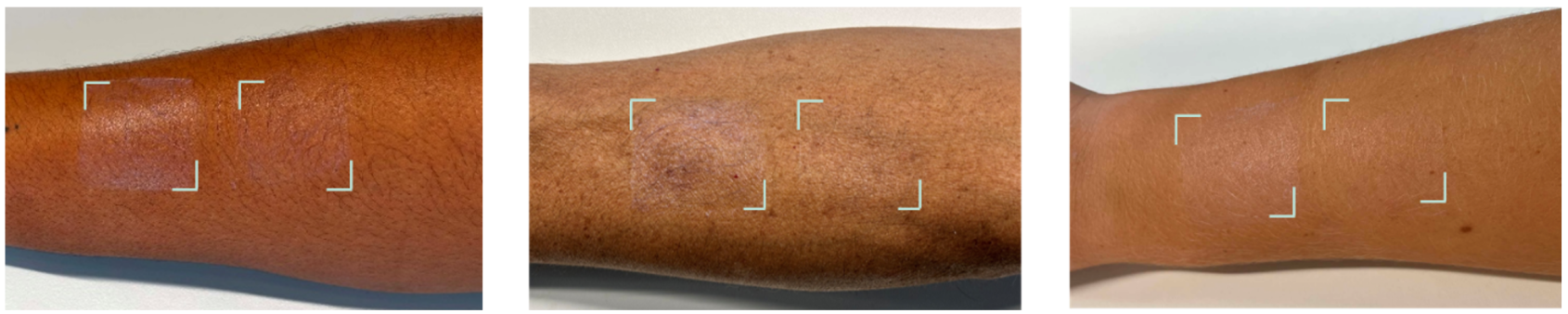
Figure 1. Side-by-side comparison of commercial mineral sunscreen (left squares in each picture) and the same mineral sunscreen fortified with LUX (right squares in each picture) in skin types V, IV, and III (left to right, respectively). The right angles define skin zones (squares) where sunscreen was applied.
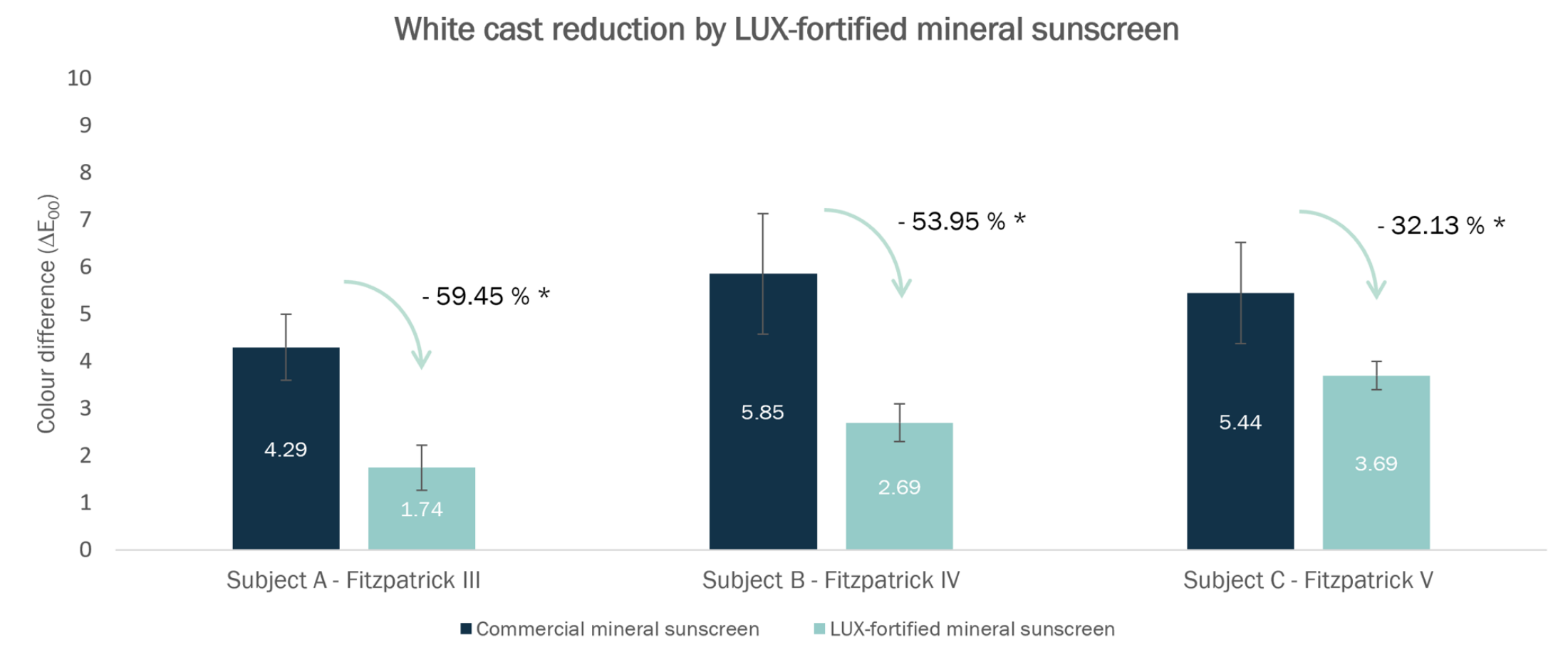
Figure 2. Bar chart showing the colour difference (DE ) of skin covered with the benchmark mineral sunscreen (dark blue) and LUX-fortified sunscreen (light blue) across three different skin types. * p < 0.05 indicates a significant white cast reduction by the LUX-fortified sunscreen.
Taken together, the results show that LUX can substantially reduce the visible colour shift caused by non-nano mineral sunscreen across different skin tones. They also point to an important formulation opportunity: rather than simply masking white cast at the surface, LUX offers a bio-based route to improving the optical aesthetics of mineral SPF while retaining the mineral filter concentration of the benchmark formulation.
Implications for Mineral SPF Formulation
Exploring the wider potential of LUX beyond white cast reduction
Reducing white cast is valuable in its own right, particularly as mineral SPF moves into products designed for frequent, everyday use. But the results also raise a broader formulation question: could the same ingredient help address more than one of the challenges associated with achieving high-performing, cosmetically elegant mineral protection?
One area of interest is colour. The LUX production process can be tuned to create a range of shades, opening the possibility of selecting the ingredient colour with the intended formulation, finish, and skin-tone needs in mind. Rather than treating colour correction as a fixed property, this could give formulators another variable to work with when developing mineral SPF for a broader range of consumers.
Other functionality is currently being investigated. Early work points to SPF-boosting and film-forming properties of LUX, although these were outside the scope of the present white cast study. In particular, research is exploring whether the combination of SPF boosting and white cast reduction could allow formulators to achieve the required protection with a lower concentration of mineral UV filters—addressing the whitening effect through more than one formulation lever.
Making these opportunities a reality will ultimately depend on the formulation itself: UV-filter system, ingredient compatibility, sensory targets, intended market, and regulatory requirements all shape the development path.
Plinius Labs combines ingredient expertise with formulation and regulatory support, enabling partners to evaluate LUX within the requirements of their own products rather than as a one-size-fits-all solution.
Towards More Elegant Mineral SPF
Meeting the expectations of everyday sun protection
As sun protection becomes a more regular part of everyday skincare and beauty routines, efficacy is only part of the formulation challenge. Products designed for daily wear must also meet increasingly high expectations for appearance, skin feel and overall application experience.
For mineral SPF, white cast remains one of the most visible barriers to achieving that cosmetic elegance. The present study demonstrates that fortifying a commercial non-nano zinc oxide sunscreen with 3% LUX significantly reduced white cast across all three skin phototypes tested, while maintaining the observed spreadability of the benchmark formulation.
LUX therefore offers a promising bio-based approach to improving the aesthetic performance of mineral sunscreen formulations—one that addresses an established formulation challenge while opening further possibilities for colour tuning and multifunctional performance as the technology continues to develop.
Explore LUX in Your Formulation
Interested in evaluating LUX in your mineral SPF system? Talk to our team about your formulation requirements, technical support, and opportunities for collaborative development.

We have a natural chemistry